
ISKCON Mayapur Is Known as the Spiritual Capital of the World
Explore the remarkable journey of Mayapur—from a peaceful village in West Bengal to an internationally renowned center of devotion, culture, and Vedic learning.

ISKCON Mayapur: The Small Bengal Town That Became a Spiritual World Capital
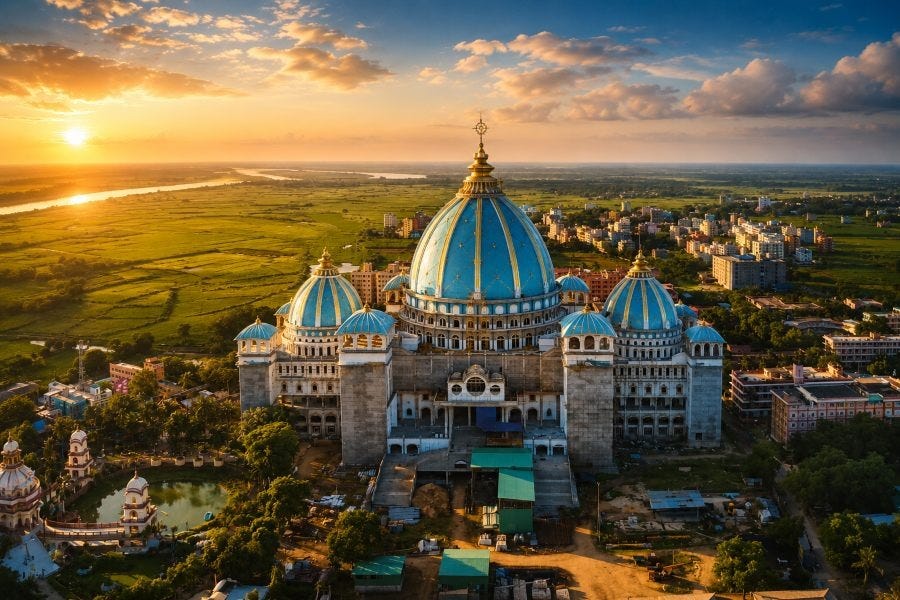
Picture a patch of marshy land beside the Ganges in rural Bengal, mostly rice fields and mango groves, so obscure that even nearby villagers barely gave it a second thought. Now picture that same patch of land drawing hundreds of thousands of pilgrims every year, hosting one of the most ambitious temple projects in Asia, and anchoring a global spiritual movement active in over a hundred countries. That shift is the real story behind ISKCON Mayapur, and it didn’t happen by accident. Every book, deity outfit, and ritual item sold today through the Official ISKCON Mayapur Store traces back to decisions made here five centuries ago, and again just a few decades back.
Most people who hear the name Mayapur assume it’s just another temple town, one of hundreds scattered across India. That assumption misses almost everything interesting about the place. Mayapur isn’t old in the way Varanasi or Puri are old. It isn’t a city that grew organically around a shrine over a thousand years. It’s something stranger: a birthplace that was lost, found again, argued over, and finally rebuilt into a planned spiritual headquarters with an architectural centerpiece unlike anything else in the Vaishnava world.
Why Mayapur? The Geography Nobody Talks About
Before getting into names and dates, it helps to understand where Mayapur actually sits and why that location matters.
Mayapur lies in the Nadia district of West Bengal, right where the Jalangi River meets the Ganges (locally called the Bhagirathi at this stretch). River confluences have always held religious weight in Indian tradition — they’re considered points where spiritual energy concentrates. But Mayapur’s importance isn’t just symbolic geography. It sits close to Navadvipa, historically one of Bengal’s great centers of Sanskrit learning, logic, and Nyaya philosophy scholarship. In other words, this wasn’t a backwater. It was an intellectual hub, a place where pandits debated grammar and metaphysics long before anyone associated it with devotional Vaishnavism.
That combination — scholarly prestige plus riverside sanctity — set the stage for what happened next.
The Birth That Changed Everything
In 1486, in a neighborhood of Navadvipa now identified as Mayapur, a child was born to Jagannatha Mishra and Sachi Devi. They named him Vishvambhara. History remembers him as Sri Chaitanya Mahaprabhu.
Chaitanya wasn’t born into obscurity. His family had scholarly standing, and by his youth he was already known as a formidable debater of Sanskrit grammar and logic. Then something shifted. After a pilgrimage to Gaya, he returned a changed man — consumed by devotion to Krishna, given to spontaneous weeping, dancing, and chanting in the streets. To onlookers who’d known him as a sharp, somewhat arrogant young scholar, this transformation looked almost like madness.
It wasn’t madness. It was the beginning of a movement that would outlive empires.
Chaitanya popularized sankirtana — congregational chanting of the names of Krishna, done publicly, loudly, and without regard for caste or social standing. That last part mattered enormously. Sixteenth-century Bengal operated under rigid social stratification. Chaitanya’s insistence that devotion was available to everyone — regardless of birth, education, or social rank — was quietly radical. Brahmins and so-called untouchables chanted side by side in his kirtans. That inclusivity is part of why the movement spread so fast; it offered something the existing religious hierarchy didn’t.

The Six Goswamis and the Blueprint for a Faith
Chaitanya himself didn’t write theological treatises. He inspired others to. He sent a group of scholars — later known as the Six Goswamis of Vrindavan — to systematically document the philosophy, ritual practice, and scriptural foundation of what would become Gaudiya Vaishnavism.
Rupa Goswami, Sanatana Goswami, Jiva Goswami, Gopala Bhatta Goswami, Raghunatha Bhatta Goswami, and Raghunatha Dasa Goswami produced an enormous body of Sanskrit literature over the following decades — commentaries, poetry, ritual manuals, philosophical treatises. Without their work, Chaitanya’s movement might have remained a regional devotional fad, forgotten within a couple of generations like so many others. Instead, it had a textual backbone that could travel, be studied, and be transmitted across centuries.
This is worth pausing on, because it explains something people often get backwards: Gaudiya Vaishnavism isn’t a simplistic, emotion-only tradition. It has serious philosophical depth — a school called Achintya Bheda Abheda, dealing with the simultaneous oneness and difference between the individual soul and the divine. That intellectual rigor, paired with accessible devotional practice, gave the tradition staying power that pure emotionalism alone never could have.
Centuries of Silence: How Mayapur Nearly Got Forgotten
Here’s a detail that surprises most people: for roughly three hundred years after Chaitanya’s disappearance in 1534, the exact location of his birthplace was genuinely disputed and largely neglected.
Rivers shift course. Settlements decline. Political upheaval — including the gradual decline of local patronage and shifting administrative boundaries under Mughal and later British rule — meant that the precise site of Chaitanya’s birth became a matter of local memory rather than documented certainty. Different groups claimed different spots as the “real” Mayapur. Some scholars argued the original site had literally been swallowed by the shifting Ganges.
This wasn’t unusual for the era. Plenty of significant historical and religious sites across India went through similar periods of obscurity before later rediscovery or restoration. What makes Mayapur’s case notable is how deliberately and methodically it was eventually resolved.
Bhaktivinoda Thakura Rediscovers the Birthplace
The person most responsible for pulling Mayapur out of historical fog was Bhaktivinoda Thakura, a 19th-century magistrate, scholar, and Vaishnava reformer.
Working as a government official gave him access to old land records, revenue documents, and local testimonies that ordinary pilgrims or priests wouldn’t have had. He cross-referenced these with scriptural descriptions of the birthplace’s surrounding geography — descriptions of specific trees, riverbanks, and neighborhood layouts mentioned in older biographical texts about Chaitanya.
In 1887, based on this research, he identified a specific site as Chaitanya’s actual birthplace and began developing it. He wasn’t just satisfied with locating a spot; he wanted it recognized as the spiritual capital it deserved to be. He wrote extensively about Mayapur’s significance and envisioned it becoming a global center of Vaishnava culture — a vision that sounded almost fantastical at the time, given that it was still a remote, undeveloped area with minimal infrastructure.
His son, Bhaktisiddhanta Sarasvati Thakura, carried this vision further. He founded the Gaudiya Math, an institution dedicated to spreading Gaudiya Vaishnavism, and he was determined to see it grow beyond India’s borders. He sent disciples abroad, something almost unheard of for an Indian religious institution at that time. One of the last instructions he reportedly gave, near the end of his life in 1937, was to a disciple named Abhay Charan De — instructing him to spread Krishna consciousness to the English-speaking world.
That disciple would later become known as A.C. Bhaktivedanta Swami Prabhupada.
Enter Srila Prabhupada: From Kolkata Ferry to a Global Mission
Prabhupada didn’t act on that instruction immediately. Decades passed. He ran a pharmaceutical business, raised a family, and continued his spiritual practice quietly. It wasn’t until 1965, at age 69, that he boarded a cargo ship, the Jaladuta, bound for New York with almost no money and a suitcase of books he’d translated himself.
What happened after that is fairly well documented: he began chanting in Tompkins Square Park, attracted a small group of curious young Americans, and within a couple of years had formally founded the International Society for Krishna Consciousness (ISKCON) in July 1966.
But here’s the part that connects back to Mayapur directly. Prabhupada never treated New York, or Los Angeles, or London as the movement’s spiritual home. Those were mission fields. He always intended for the movement’s headquarters to be rooted in the land where Chaitanya was born. In the early 1970s, he began developing land in Mayapur for exactly that purpose, describing plans for a massive temple complex that would eventually become the international center of the entire movement.
Why Prabhupada Chose Mayapur as ISKCON’s World Headquarters
This wasn’t sentimentality. There was clear reasoning behind it.
Theological continuity: Locating the headquarters at Chaitanya’s actual birthplace tied the modern movement directly to its 16th-century origin, rather than presenting ISKCON as something invented independently in the West.
Prophetic weight: Chaitanya himself is recorded in Gaudiya texts as having predicted that his name would be chanted in every town and village of the world. Establishing a headquarters at his birth site gave that prophecy a literal, geographic anchor.
Pilgrimage infrastructure: Bengal already had an existing devotional culture around Navadvipa and the broader Nadia region, giving Mayapur a built-in base of local support and religious tourism potential.
A statement of intent: Building something enormous and permanent in a relatively undeveloped rural area sent a message — this movement wasn’t a passing Western fad, it was here to stay, rooted in Indian soil.
Prabhupada passed away in 1977, before seeing his full vision for Mayapur realized. But he left detailed instructions and a community of dedicated followers determined to complete it.

The Temple of the Vedic Planetarium: Ambition on a Different Scale
If you’ve seen photos of Mayapur in recent years, you’ve probably seen the Temple of the Vedic Planetarium (TOVP) — an enormous domed structure under construction for decades, designed to be one of the largest religious monuments in the world.
The scale here is genuinely unusual. This isn’t a renovation or an expansion of an existing shrine. It’s a from-scratch architectural undertaking combining a massive worship hall, a planetarium presenting Vedic cosmology, and detailed craftsmanship involving artisans and materials sourced internationally. Construction has spanned generations, funded largely through donations from ISKCON members and well-wishers worldwide — a genuinely global crowdfunded monument, long before crowdfunding was a common term.
Why go to such lengths? Because the temple isn’t meant to just serve local worshippers. It’s designed as a destination — a structure significant enough to draw people who might never otherwise encounter Gaudiya Vaishnava philosophy, and once they’re there, to communicate centuries of cosmological and devotional teaching through architecture itself rather than lectures alone.
Daily Life in Mayapur Today: Not Just a Museum Piece
It would be a mistake to think of Mayapur purely as a historical site or an architectural project. It’s a living, functioning community.
Thousands of devotees reside there permanently, running:
Gurukulas (traditional residential schools) educating children in both Vedic studies and standard academics
Farming projects based on cow protection and organic agriculture, reflecting older Vedic economic models
Guest houses and pilgrim accommodations, ranging from simple rooms to more comfortable options for international visitors
Book publishing and distribution operations, connected to the Bhaktivedanta Book Trust (BBT), which prints and distributes Prabhupada’s translations and commentaries in dozens of languages
Prasadam kitchens, feeding both residents and visiting pilgrims daily, often at a scale that would surprise anyone unfamiliar with temple food distribution logistics in India
None of this runs itself. It takes ongoing management, funding, and coordination — which is part of why an entire retail and outreach infrastructure has grown around the temple, including its online store, to keep both the mission and its physical upkeep financially sustainable.
Festivals That Turn a Small Town Into a City Overnight
If you want to see Mayapur’s pull in action, visit during Gaura Purnima — the celebration of Chaitanya’s birth, usually falling in February or March depending on the lunar calendar.
During this period, a town that might otherwise host a modest, steady stream of visitors suddenly swells with tens of thousands of pilgrims from across India and abroad. Temporary accommodation gets set up. Kitchens run around the clock. Kirtans continue late into the night. It’s chaotic in the way that only genuinely important religious festivals are — overcrowded, occasionally disorganized, and completely unforgettable for those who attend.
Other notable occasions include Janmashtami (Krishna’s birth celebration) and Kartik month, when devotees observe additional vows and rituals. Each of these draws its own wave of visitors, though none quite match Gaura Purnima in scale.
What Makes Mayapur Different from Other Pilgrimage Sites
India has no shortage of significant pilgrimage destinations. So what actually distinguishes Mayapur from, say, Vrindavan, Puri, or Varanasi?
A few things stand out:
It’s simultaneously ancient and modern. The spiritual claim goes back over 500 years, but much of the physical infrastructure — including its most famous landmark, the TOVP — is contemporary construction.
It’s genuinely international. Walk through Mayapur on any given day and you’ll hear a dozen languages. The resident population includes people from Russia, Eastern Europe, Latin America, and beyond — not just Indian devotees.
It combines scholarship with devotion. Its historical roots in Navadvipa’s intellectual tradition mean Mayapur has never been purely about emotional worship; philosophical education remains central to its identity.
It functions as an institutional headquarters, not just a shrine. Decisions affecting ISKCON temples worldwide are made through governance structures based partly in Mayapur.
The Governance Side: Who Actually Runs Mayapur?
People rarely think about the administrative machinery behind a major pilgrimage site, but it’s worth a mention because it explains why Mayapur has been able to sustain such an ambitious build-out over decades rather than stalling out.
ISKCON as a whole operates under a Governing Body Commission (GBC), a structure Prabhupada himself set up before his passing specifically so the movement wouldn’t depend on a single successor guru holding absolute authority. That decision, made in the final years of his life, turned out to be one of the more consequential ones in the organization’s history. Movements built entirely around one charismatic leader tend to fracture badly once that leader is gone. ISKCON has had its share of internal disputes and controversies over the decades, certainly, but the distributed governance model gave it enough institutional flexibility to survive leadership transitions that might have splintered a more centralized structure.
Mayapur holds particular weight in this system because the GBC’s annual meetings are held there, alongside the birthplace celebrations. Temple presidents, project managers, educators, and financial administrators from ISKCON centers across dozens of countries converge on Mayapur not just to worship, but to coordinate. It functions, in a very literal sense, as a headquarters would — except the work being coordinated is spiritual education, publishing, and community welfare rather than anything commercial in the conventional sense.
The Practical Side: Books, Prasadam, and Keeping the Mission Funded
Religious movements, however spiritually motivated, still need practical funding to survive and expand. Mayapur’s economy runs substantially on:
Sale of BBT-published books — Bhagavad Gita editions, Srimad Bhagavatam volumes, biographies, and children’s literature aimed at introducing younger readers to Vaishnava philosophy
Devotional items — puja paraphernalia, instruments like mridangams and kartals used in kirtan, deity garments, and incense
Pilgrim accommodation and prasadam programs
Donations tied to ongoing temple construction and maintenance
This is where the tradition’s ancient teachings and modern logistics genuinely intersect. Someone browsing devotional books or instruments today, whether physically at Mayapur or through channels tied to it, is participating in the same economic model that has funded Vaishnava institutions for generations — just adapted for a global, digitally connected audience.
Why This History Still Matters in 2026
It would be easy to treat all of this as interesting-but-distant history. It isn’t. The reason Mayapur functions today the way it does — as an active pilgrimage site, a functioning temple community, a publishing hub, and an educational center — is a direct continuation of decisions made by specific people: Chaitanya’s original teaching, the Goswamis’ scholarship, Bhaktivinoda Thakura’s rediscovery, Bhaktisiddhanta Sarasvati’s global ambition, and Prabhupada’s execution of that vision on foreign soil and back home again.
Understanding that chain matters because it explains why Mayapur isn’t just another dot on a pilgrimage map. It’s the product of a five-century relay race, where each generation picked up something nearly lost and carried it further than the previous one thought possible. A rural birthplace that was once genuinely at risk of being forgotten is now a place that draws visitors, scholars, and devotees from every part of the world.
That’s a rare kind of continuity. Most religious sites either stay frozen as historical relics or lose their original character entirely as they modernize. Mayapur has managed something harder — staying rooted in a specific 16th-century event while continuously building, expanding, and adapting for a genuinely global 21st-century audience.
Whether someone visits as a curious traveler, a devoted pilgrim, or simply someone researching Bengal’s religious history, Mayapur offers something unusual: a place where you can trace an unbroken line from a single birth in 1486 to a functioning global institution today, standing right there on the same riverbank where it all began.
The Bigger Picture
Step back far enough, and Mayapur’s story stops being just a regional religious history and starts looking like a case study in institutional resilience. Ideas that begin small and local — a single man singing in the streets of a Bengal town in the 1500s — don’t usually survive five centuries intact, let alone grow into something with a genuinely worldwide footprint. Most such movements dissolve, get absorbed into larger traditions, or fade into historical footnotes.
Mayapur’s continuity happened because successive generations kept doing two things simultaneously: preserving the philosophical and scriptural core without diluting it, while also being willing to rebuild the physical and institutional infrastructure from scratch when circumstances demanded it. Bhaktivinoda Thakura didn’t just preserve old texts; he did fieldwork to physically relocate a lost site. Prabhupada didn’t just teach Vaishnava philosophy; he built an organization capable of outliving him by decades. That combination — doctrinal fidelity plus institutional pragmatism — is rarer than it sounds, and it’s the actual reason Mayapur exists in its current form rather than as a footnote in a history book about medieval Bengal.
For anyone studying comparative religion, institutional history, or simply trying to understand how a small town in rural Bengal became a genuinely international destination, that combination is the real lesson worth taking away.
A Few Common Questions People Ask About Mayapur
Since a fair number of readers come across Mayapur for the first time through a general search rather than prior religious background, a handful of questions come up repeatedly. It’s worth addressing them directly rather than assuming everyone already knows the basics.
Is Mayapur the same as Vrindavan?
No, and this confusion comes up often. Vrindavan, near Mathura in Uttar Pradesh, is associated with Krishna’s childhood pastimes according to Vaishnava tradition. Mayapur, in West Bengal, is associated with Chaitanya Mahaprabhu, who Gaudiya Vaishnavas regard as Krishna’s own combined incarnation appearing to teach devotion through his own example. The two towns are connected theologically but geographically distinct, roughly 1,500 kilometers apart.
Can non-Hindus or first-time visitors go to Mayapur?
Yes. Mayapur’s guest houses and temple complex welcome visitors regardless of background. Plenty of tourists arrive purely out of architectural or cultural curiosity and end up staying longer than planned once they see the scale of the place and experience an evening kirtan.
How is Mayapur different from ISKCON’s temple in Kolkata or elsewhere?
Local ISKCON temples in cities function more like regular neighborhood worship centers, offering daily programs for local congregations. Mayapur operates on a different scale entirely — it’s the movement’s spiritual point of origin and its administrative center rolled into one, not a satellite branch.
Why does the temple construction take so long?
The Temple of the Vedic Planetarium involves architectural and engineering challenges rarely attempted at this scale for a religious structure, combined with funding that depends heavily on voluntary donations rather than a fixed budget. Large domed structures without steel reinforcement in the traditional style require specialized craftsmanship, and sourcing artisans skilled in that specific kind of stonework and dome construction isn’t quick or simple.