
Mapping the Soul: Decoding Transcendental Emotion in Rupa Goswami’s Bhakti Rasamrita Sindhu
An analytical exploration of Rupa Goswami’s foundational treatise on the science of Divine Rasa and devotional psychology.

A Comprehensive Mapping of Transcendental Emotion: The Bhakti-Rasamrita-Sindhu
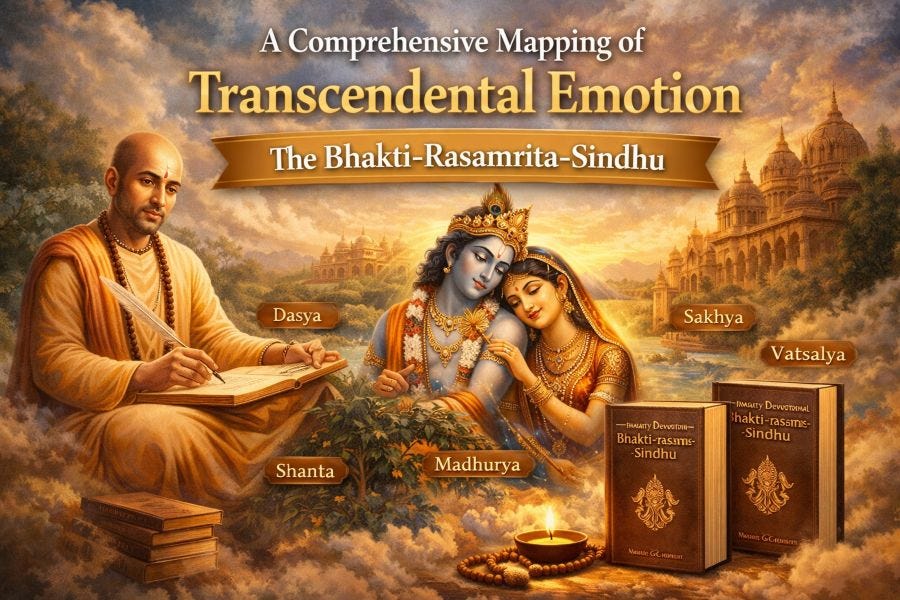
In the vast landscape of spiritual literature, very few works achieve the rare balance of poetic beauty, philosophical depth, and practical guidance. One such timeless masterpiece is the Bhakti-rasamrita-sindhu, composed by the great saint Rupa Goswami. This extraordinary text is not merely a theological treatise—it is a detailed map of the soul’s emotional journey toward divine love.
For readers seeking a deeper understanding of devotion beyond ritual and belief, the ISKCON Store Bhakti Rasamrita Sindhu Set of Two Vol offers a gateway into the science of transcendental emotions. Within its pages lies a structured exploration of how ordinary feelings can evolve into pure, spiritual ecstasy centered on the Supreme.
Foundation of Bhakti
At its core, Bhakti is not simply devotion in the conventional sense. It is a dynamic, living relationship between the individual soul and the Supreme Personality of Godhead, Krishna. The Bhakti-rasamrita-sindhu defines Bhakti as a process that is free from selfish desires and focused entirely on pleasing the Divine.
Unlike paths that emphasize renunciation or intellectual speculation, Bhakti celebrates emotional engagement. It teaches that feelings—when purified—are not obstacles but powerful vehicles for spiritual realization.
Rupa Goswami systematically categorizes devotion into stages, ensuring that seekers can understand exactly where they stand and how they can progress. This clarity transforms spirituality from a vague concept into a tangible, achievable journey.
The Meaning of “Rasa” in Spiritual Context
The term “rasa” is central to the Bhakti-rasamrita-sindhu. In Sanskrit, “rasa” refers to flavor, taste, or emotional essence. In the spiritual realm, it signifies the unique relationship one shares with Krishna.
Rupa Goswami identifies five primary rasas:
Shanta (peaceful neutrality)
Dasya (servitude)
Sakhya (friendship)
Vatsalya (parental affection)
Madhurya (conjugal love)
Each rasa represents a distinct way of experiencing divine love. These are not imaginary constructs but deeply realized emotional states that evolve through practice and grace.
What makes this concept revolutionary is that it validates emotion as the highest expression of spirituality. Instead of suppressing feelings, Bhakti refines and elevates them.
The Structured Science of Devotion
One of the most remarkable aspects of the Bhakti-rasamrita-sindhu is its scientific approach. Rupa Goswami does not leave devotion to chance—he outlines a step-by-step progression.
The journey begins with:
Faith (Shraddha)
Association with devotees (Sadhu-sanga)
Practice of devotional activities (Bhajana-kriya)
Removal of unwanted habits (Anartha-nivritti)
Steadiness (Nishtha)
Taste (Ruchi)
Attachment (Asakti)
Ecstatic emotion (Bhava)
Pure love (Prema)
This progression provides a clear roadmap for spiritual advancement. It shows that divine love is not an abstract ideal but a measurable, experiential reality.
The Role of Practice in Awakening Emotion
While the goal of Bhakti is transcendental emotion, the process begins with discipline. Rupa Goswami emphasizes regulated practices such as chanting, hearing, and remembering Krishna.
These practices may initially feel mechanical, but they gradually awaken deeper feelings. Just as a musician practices scales before creating art, a devotee follows discipline before experiencing spontaneous devotion.
Over time, practice transforms into passion. What begins as effort evolves into natural attraction, and eventually into overwhelming love.
Bhava: The Dawn of Spiritual Emotion
Bhava is described as the first stage of genuine spiritual emotion. It is not yet full love, but it carries the essence of divine affection.
At this stage:
The heart becomes soft and receptive
One experiences deep longing for Krishna
Material desires begin to fade
Bhava is compared to the first rays of the sun before sunrise. It signals that the soul is awakening to its true nature.
This stage is rare and cannot be artificially imitated. It arises naturally through sincere practice and divine grace.
Read Also:- Krishna and Sudama
Prema: The Ultimate Goal
Prema is the culmination of Bhakti—the highest state of divine love. It is characterized by complete selflessness and intense emotional connection with Krishna.
In Prema:
The devotee lives entirely for Krishna’s pleasure
Every moment is filled with spiritual joy
Separation from Krishna feels unbearable
This level of devotion transcends ordinary understanding. It is not bound by logic or reason but flows from the deepest core of the soul.
Rupa Goswami describes Prema with extraordinary detail, making it both awe-inspiring and accessible as a goal.
The Influence of Chaitanya Mahaprabhu
The teachings of the Bhakti-rasamrita-sindhu are deeply rooted in the life and philosophy of Chaitanya Mahaprabhu.
Chaitanya Mahaprabhu exemplified the highest form of devotion—ecstatic love for Krishna. His life served as a living demonstration of the principles that Rupa Goswami later systematized.
Under his guidance, devotion was not just taught but experienced. This experiential foundation gives the Bhakti-rasamrita-sindhu its authenticity and power.
Regulated Devotion vs. Spontaneous Devotion
Rupa Goswami distinguishes between two types of Bhakti:
Vaidhi Bhakti (regulated devotion)
Raganuga Bhakti (spontaneous devotion)
Vaidhi Bhakti is driven by rules and discipline. It is essential for beginners, as it establishes a strong foundation.
Raganuga Bhakti, on the other hand, arises from deep attraction. It is natural, effortless, and emotionally intense.
This distinction helps practitioners understand that rules are not the конечный goal—they are stepping stones toward spontaneous love.
The Psychology of Devotional Emotions
One of the most fascinating aspects of the Bhakti-rasamrita-sindhu is its psychological depth.
Rupa Goswami analyzes emotions with precision, identifying:
Permanent emotions (Sthayi-bhava)
Transitory emotions (Vyabhicari-bhava)
Involuntary expressions (Anubhava)
Physical transformations (Sattvika-bhava)
This detailed classification shows that spiritual emotion is not chaotic—it follows a structured pattern.
Modern psychology often studies emotions from a material perspective, but Bhakti-rasamrita-sindhu elevates this understanding to a spiritual dimension.
Relevance in the Modern World
Despite being written centuries ago, the Bhakti-rasamrita-sindhu remains incredibly relevant today.
In an age of emotional confusion, it offers clarity. In a world of superficial relationships, it presents the deepest form of connection.
People today struggle with:
Loneliness
Anxiety
Lack of purpose
This text addresses these issues at their root by reconnecting individuals with their spiritual identity.
The Transformative Power of Devotional Literature
Reading the Bhakti-rasamrita-sindhu is not just an intellectual exercise—it is a transformative experience.
As one studies the text:
The mind becomes purified
The heart becomes softened
A higher taste begins to develop
This transformation occurs gradually but steadily. It reshapes one’s priorities, values, and perceptions.
Why This Text Is Considered a Masterpiece
The Bhakti-rasamrita-sindhu stands out for several reasons:
Systematic Presentation
It organizes devotion into a clear, logical structure.
Emotional Depth
It explores feelings at a level rarely seen in spiritual literature.
Practical Guidance
It provides actionable steps for spiritual progress.
Universal Appeal
Its teachings transcend cultural and religious boundaries.
How to Approach the Bhakti-Rasamrita-Sindhu
For new readers, this text may seem complex. However, with the right approach, it becomes deeply rewarding.
Study tips:
Read slowly and reflect
Take notes on key concepts
Apply teachings in daily life
Seek guidance from experienced practitioners
Consistency is more important than speed.
The Living Legacy of Rupa Goswami
The influence of Rupa Goswami extends far beyond his writings. His teachings continue to inspire millions of devotees worldwide.
Through organizations like the International Society for Krishna Consciousness, his work has reached a global audience.
His vision of devotion as a science of love remains as powerful today as it was centuries ago.
Conclusion: A Map to Divine Emotion
The Bhakti-rasamrita-sindhu is more than a book—it is a map of the soul’s journey toward divine love.
It teaches that spirituality is not about escaping emotions but transforming them. It shows that the highest truth is not dry philosophy but vibrant, living love.
For anyone seeking depth, clarity, and genuine transformation, this text offers a path that is both profound and practical.
The journey it describes is not easy—but it is deeply rewarding. And for those who walk this path sincerely, the destination is nothing less than eternal, transcendental bliss.