
What Is Gopi Chandan? Complete Guide to Its Origin, Benefits, and How to Apply It Properly
The Sacred Clay of Vrindavan That Millions of Devotees Apply Every Morning — And Why It Changes Everything

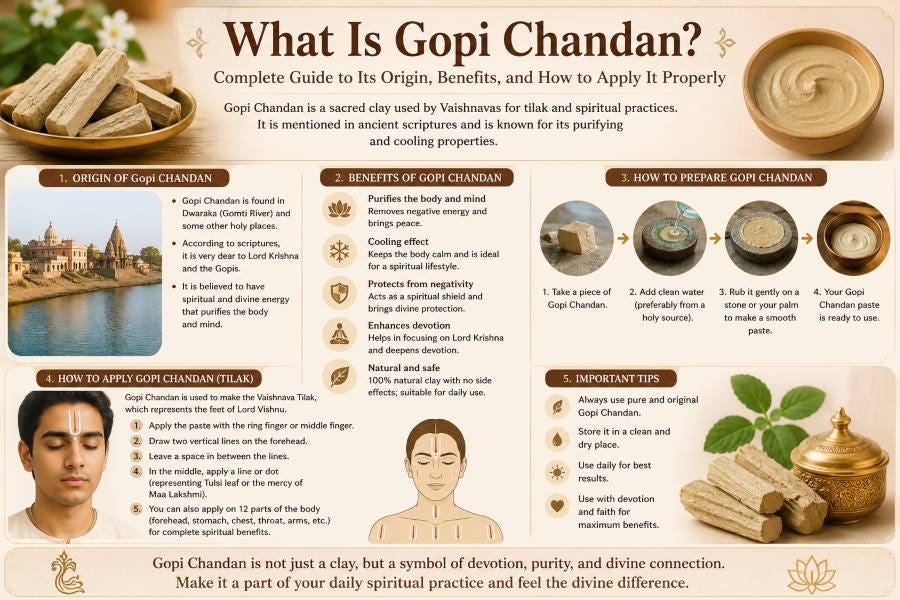
Imagine starting your morning before the sun rises. The house is still. You light a lamp, sit before your altar, and reach for a small piece of pale yellow clay. You add a few drops of water, mix it on your palm, and draw two vertical lines on your forehead. That act — quiet, deliberate, five thousand years old — is the practice of applying Gopi Chandan.
But what exactly is this clay? Why do millions of devotees across the world consider it irreplaceable? And is there a right way — and a wrong way — to use it? This guide covers all of that. Whether you are just beginning your journey in Vaishnava practice or have been applying tilak for years, there is something here worth knowing.
For those looking to source authentic Gopi Chandan, the ISKCON Mayapur Official Store carries pure, traditionally sourced Gopi Chandan blocks and related devotional supplies trusted by devotees worldwide.
The Name Itself Tells a Story
Most people assume “Gopi Chandan” means “sandalwood paste used by the Gopis.” That is a reasonable guess — chandan does mean sandalwood in Sanskrit. But Gopi Chandan is not sandalwood at all. It is clay. Sacred, naturally mined, pale yellow clay from the holy region of Dwarka, Gujarat.
So why call it chandan?
In Vaishnava thought, the word chandan here carries a deeper meaning — purity, cooling, and auspiciousness. The clay is called chandan not because of its botanical origin, but because of what it does: it cools the body, purifies the mind, and connects the devotee to something sacred. The “Gopi” in the name refers to the cowherd maidens of Vrindavan, the Gopis — whose devotion to Lord Krishna is considered the highest expression of love in Gaudiya Vaishnava philosophy.
The name is an identity, not a botanical description.
Where Does Gopi Chandan Actually Come From?
Here is something that surprises many people: Gopi Chandan is not from Vrindavan. It does not come from the banks of the Yamuna or the ghats of any sacred river in Uttar Pradesh. It is mined from a dry lake bed near Dwarka, on the western coast of Gujarat — a place called Gopi Talav (Gopi Lake), located roughly 19 kilometers from the main Dwarka temple.
This distinction matters.
Dwarka is considered the ancient kingdom of Lord Krishna — the place where He lived and ruled as a king after leaving Vrindavan. The Gopis of Vrindavan, unable to bear the separation from Krishna after He relocated to Dwarka, traveled long distances just to see Him. According to the Garga Samhita, they once met secretly with Krishna near a forest outside the royal city, danced the Rasa Lila with Him one final time, and then bathed together in a nearby lake.
As the Gopis bathed, their bodily adornments — the sacred cosmetics, the sandalwood paste, the saffron and turmeric from their skin — mingled with the water and slowly settled into the clay at the lake’s bottom. Over time, that clay absorbed the essence of their devotion. That sanctified earth became what we now call Gopi Chandan.
This is the story found in the Garga Samhita. It explains why the clay is considered so potent — not because of its mineral composition, but because of what it carries spiritually.
Some traditions add another layer: when the Gopis resolved to give up their physical forms and merge into the sacred soil of Dwarka, their devotion itself transformed the earth. Either way, the consensus in Vaishnava scripture is clear — this clay is no ordinary clay.
What Gopi Chandan Is Made Of
On a purely physical level, Gopi Chandan is a soft mineral clay. It forms naturally in specific regions of Dwarka and Gopi Talav, shaped by centuries of geological conditions unique to that geography. Its color ranges from creamy white to pale yellow depending on where it is sourced.
Key characteristics:
No chemical additives — authentic Gopi Chandan is entirely unprocessed
No artificial fragrance — though some devotees note a faint, natural earthy scent
Soft texture — it dissolves easily in water, becoming a smooth paste ideal for tilak application
Non-toxic and skin-safe — it has been applied to human skin for thousands of years
What makes it distinct from any other white clay you might find? Spiritually, everything. Physically, the mineral composition of the Dwarka region is unique — the clay from Gopi Talav has specific properties that clay from other regions simply does not replicate. Commercially sold “Gopi Chandan” that is not sourced from Dwarka is considered inauthentic in traditional Vaishnava practice.
What the Scriptures Say About It
The Padma Purana, one of the eighteen major Puranas, contains a striking statement about Gopi Chandan: if a devotee performs Vedic rituals like yajnas or homas while wearing this tilak, even if mantras are chanted with incorrect pronunciation or a procedural error occurs, the full spiritual benefit of those rituals is still received.
That is a remarkable claim. It suggests that Gopi Chandan acts as a kind of spiritual protection — a buffer that compensates for human imperfection in devotional practice.
The Brahmanda Purana specifies the method of application in detail, including which finger to use and how to shape the marks. The Garga Samhita recounts the origin story. The Vaishnava Amrita provides elaborate descriptions of the tilak’s protective qualities — guarding the wearer from negative energies, evil influences, bad dreams, and spiritual obstacles.
Lord Chaitanya Mahaprabhu, the 15th-century saint who revived the Gaudiya Vaishnava movement, is described in the Chaitanya Bhagavata as having sent His students home if they arrived without Gopi Chandan tilak. His point was simple: if you come to learn about devotion, first demonstrate it through your appearance.
That standard — tilak as a visible mark of spiritual identity — has carried through to ISKCON and Gaudiya Vaishnavas worldwide to this day.
The Twelve Places: Your Body as a Temple
One of the most distinctive aspects of traditional Gopi Chandan practice is that tilak is not applied only on the forehead. According to Vaishnava scripture, the clay should be applied to twelve specific places on the body, each corresponding to a divine name of Lord Vishnu.
As each mark is made, a different name is chanted:
Body Part
Divine Name
Forehead
Keshava
Abdomen
Narayana
Chest / Heart
Madhava
Throat
Govinda
Right side of abdomen
Vishnu
Left arm
Madhusudana
Right ear
Trivikrama
Left side of abdomen
Vamana
Left arm (upper)
Shridhar
Right ear (back)
Hrishikesha
Back
Padmanabha
Shoulder
Damodara
Each mark transforms that part of the body into a sacred space — a consecrated point dedicated to the Lord. The Vaishnava philosophy underlying this is not abstract. It holds that the human body is literally a temple. Gopi Chandan is the ritual by which that temple is recognized and dedicated.
Applying tilak on all twelve points, with the appropriate mantras, is considered a complete act of consecration. Many devotees in ISKCON do this every morning as part of their sadhana — their daily spiritual practice.
The Shape of the Mark and What It Represents
The Gaudiya Vaishnava tilak is called urdhva pundra — “upward mark.” It consists of two vertical lines drawn from the root of the nose upward toward the hairline, with a small oval space left in the middle.
That shape is not arbitrary.
The two lines represent the two feet — the heel and the toe — of Lord Vishnu, viewed from above
The oval in the center represents the Tulasi leaf, sacred to Lord Vishnu
The upward direction (urdhva) is symbolic: it points toward liberation, toward Goloka Vrindavan, toward the spiritual realm above
The mark is sometimes described as an imprint of the lotus feet of the Lord on the devotee’s forehead. A Vaishnava wearing this tilak is, in essence, declaring: “I carry the Lord on my brow. I am surrendered. I am His servant.”
That declaration, made silently through clay on skin, is profoundly powerful in its simplicity.
The Real Benefits of Gopi Chandan — Spiritual and Beyond
Let’s address this honestly. The “benefits” of Gopi Chandan are not the kind of benefits you can measure in a laboratory. They belong to a different framework — one rooted in devotional practice, psychological discipline, and spiritual intention.
1. Identity and Remembrance
The most immediate benefit is simple: the tilak reminds you of who you are. Every time you catch your reflection in a window or a mirror, you see the mark. That visual cue pulls the mind back to Krishna consciousness. In a world full of distractions, that constant reminder has real psychological weight.
2. Consecration of the Body
Applying tilak shifts how a devotee relates to their own body. Rather than seeing the body as a source of sensory pleasure or a problem to manage, the tilak reframes it as a dedicated vessel. This shift in perspective is at the heart of Bhakti yoga.
3. Spiritual Protection
Vaishnava scriptures consistently describe Gopi Chandan as offering protection — from negative influences, from spiritual obstacles, from the kinds of internal disturbances that derail serious practice. Whether one interprets this literally or metaphorically, the protective intention embedded in the tilak application ritual is clear.
4. Connection to the Parampara
When you apply Gopi Chandan, you are doing something that Vaishnavas have done for thousands of years. Lord Chaitanya wore it. The six Goswamis of Vrindavan wore it. Srila Prabhupada wore it. Every ISKCON devotee worldwide wears it. That continuity — being part of an unbroken tradition — carries its own quiet power.
5. Preparation for Practice
Tilak is traditionally applied before chanting, before puja, before any devotional activity. It signals to the mind that a transition is happening — that one is stepping from ordinary activity into sacred practice. This kind of ritual framing genuinely improves focus and intentionality.
Why Authentic Gopi Chandan Matters
Not all commercially available “tilak clay” is authentic Gopi Chandan. Some products use white kaolin clay or other mineral substitutes colored to appear similar. The difference might not be visible, but for a serious practitioner, it matters enormously.
Authentic Gopi Chandan:
Is sourced from Gopi Talav, Dwarka, Gujarat
Has no chemical treatment or artificial coloring
Dissolves smoothly in a small amount of water
Has a natural, faintly earthy smell
Comes in blocks or pressed forms — not as a fine, perfectly uniform powder (which can indicate industrial processing)
When purchasing, look for clear sourcing information. Stores affiliated with ISKCON, like the ISKCON Mayapur Official Store, source their Gopi Chandan through established devotional supply chains that prioritize authenticity.
How to Apply Gopi Chandan Properly: Step-by-Step
This is where many newcomers feel uncertain. The process is simpler than it looks, and once you do it a few times, it becomes fluid and natural.
What You Need
One block or piece of Gopi Chandan
A small amount of clean water
Either a smooth stone or the palm of your left hand as a mixing surface
The ring finger or middle finger of your right hand for application
Step-by-Step Application
Step 1 — Prepare the paste
Pour a small amount of water into your left palm or onto a clean stone. Rub the Gopi Chandan block gently against the surface, adding tiny amounts of water as needed, until you have a smooth, creamy paste. It should be thick enough to hold its shape but fluid enough to apply evenly.
Step 2 — Begin at the forehead
Using the ring finger of your right hand (or the ball of your middle finger, per the Brahmanda Purana), take a small amount of paste. Place your finger at the bridge of your nose and draw a firm, upward line toward your hairline. Lift the finger, move it slightly to the right, and draw a parallel line. The space between the two lines should be left clear — this is the tulasi leaf shape in the center.
According to the Brahmanda Purana, avoid using your fingernail to create the gap. Use a thin damp cloth over your finger to shape the space cleanly.
Step 3 — Continue to the other eleven points
Move through the body systematically, applying smaller marks at each of the twelve traditional locations. At each point, chant the corresponding name of the Lord quietly or mentally.
Step 4 — Complete with the head
After washing your hand, use whatever water remains to touch the top of your head (the area of the shikha), chanting: Om Vasudevaya Namaha.
Step 5 — Let it dry naturally
Allow the tilak to dry on its own. Once dry, it becomes a firm, clean mark that will last through your morning practice and into the day.
Common Mistakes to Avoid
Using too much water — the paste becomes too thin and won’t hold its shape
Rushing the preparation — a rough paste applies unevenly and can feel scratchy
Skipping the mantras — the application without the accompanying names is considered incomplete in traditional practice
Using artificial substitutes — white toothpaste or cosmetic clay is not a replacement; the spiritual intention matters
Gopi Chandan and ISKCON: A Daily Discipline
In ISKCON temples worldwide, applying Gopi Chandan is one of the first acts of the morning. Devotees rise before sunrise, bathe, and apply tilak before engaging in their morning program — which includes chanting japa, attending mangala arati, and participating in kirtan.
Srila Prabhupada, the founder of ISKCON, was consistently seen wearing Gopi Chandan tilak and emphasized its importance not as an optional external decoration but as an integral part of a devotee’s identity. He noted that tilak, kanti mala (tulasi neck beads), and the shaved head were the three visible markers that identified a Vaishnava from a distance.
The idea is simple: your appearance should reflect your practice. If you are practicing Krishna consciousness internally, let it show externally.
Gopi Chandan vs Other Tilak Traditions
Vaishnavism is not a monolithic tradition — different sampradayas (lineages) use different tilak styles and materials.
Sri Vaishnavas (followers of Ramanuja) use white clay from anthills, with a central red line representing Lakshmi Devi
Shaivites use vibhuti (sacred ash) in horizontal lines
Gaudiya Vaishnavas (the ISKCON tradition) specifically use Gopi Chandan in the urdhva pundra vertical-line format
Each style is a statement of theological identity. The Gopi Chandan urdhva pundra specifically signals allegiance to the Gaudiya sampradaya — the line descending from Lord Chaitanya, through the six Goswamis of Vrindavan, through Srila Bhaktivinoda Thakura and Srila Bhaktisiddhanta Sarasvati, to Srila Prabhupada and the worldwide ISKCON movement.
Storing and Caring for Your Gopi Chandan
A block of Gopi Chandan can last for many months with proper care.
Keep it dry — moisture will cause it to soften and deteriorate over time. Store it in a dry, cool place, away from direct sunlight.
Use a designated dish or stone for preparation — having a dedicated tilak stone adds ritual consistency to the practice
Handle it with clean hands — Gopi Chandan is considered a sacred object; approach it with that intention
Don’t drop it — blocks can crack or break; once broken, pieces can still be used but store them together in a small container
If you travel frequently, you can keep a small prepared paste in a sealed container for a few days, though freshly prepared paste is always preferred.
A Practice That Lives Between the Ancient and the Everyday
There is something unusual about Gopi Chandan. It is ancient — its story is thousands of years old, its scriptures predate most world religions — and yet it is also quietly practical. You wake up, you prepare a small paste on your palm, you draw two lines on your forehead, and you walk into your day carrying an invisible declaration of belonging.
No app, no notification, no external reminder required. Just clay, water, and the intention to remember.
That is the quiet power of this practice. Not dramatic, not loud. Just consistent. Day after day after day, in temples and apartments and ashrams across the world, Vaishnavas are doing exactly what the Gopis did five thousand years ago — using that sacred earth from Dwarka to mark themselves as devotees, to consecrate their bodies, and to walk through life with Krishna in mind.
If you have been curious about starting this practice, the barrier is lower than you think. A single block of authentic Gopi Chandan, sourced from a trusted devotional supplier, is all you need to begin.
Final Thoughts
Gopi Chandan is not just a piece of clay. It carries a story — of devotion, separation, longing, and divine grace. It is the physical manifestation of the Gopis’ love for Krishna, pressed into the earth of Dwarka, waiting to be dissolved in water and carried forward into the day by another devotee, in another century, on another continent.
When you understand that history, applying tilak stops being a routine and becomes something closer to a conversation across time. You are participating in a tradition that has never broken. And that, in itself, is worth something.